Cheap vs Expensive Skincare: Is It Worth It?
Skincare prices can range from a few dollars to hundreds, but does spending more actually mean better results? This guide breaks down what you’re really paying for in cheap vs. expensive skincare, which ingredients truly matter, and where you can safely save or should invest for healthier, more effective skin.

Whether it’s a $10 drugstore find or a $150 luxury balm, the most effective skincare is the one you actually use every day.
Walk into any drugstore and you’ll find a retinol serum for $12. Walk into a department store and you’ll find another one for $320. Both bottles promise smoother skin, fewer wrinkles, and a more radiant complexion. Both contain retinol. So what exactly are you paying for when you spend more — and is any of it actually worth it?
This is one of the most fiercely debated questions in the beauty world, and the answer is more nuanced than either the luxury skincare industry or the budget beauty community would like you to believe. The truth is: sometimes expensive skincare is genuinely superior. Sometimes it’s pure marketing. And sometimes the $8 drugstore product outperforms the $200 prestige one in head-to-head clinical testing.
This article will walk you through everything you need to know to make smarter decisions about where to spend and where to save — from how to read an ingredient list, to which product categories are worth the splurge, to the specific ingredients that science actually backs.
The Price of a Skincare Product: What Are You Actually Paying For?
Before we can compare cheap and expensive products, we need to understand what drives the price of skincare in the first place. The sticker price of a moisturizer reflects a surprisingly complex mix of factors — and actual ingredient quality is only one of them.
Formulation and Research
Developing a truly effective skincare formula is expensive. It requires cosmetic chemists, stability testing, clinical trials, dermatologist consultations, and years of iteration. Some luxury brands genuinely invest in this process, producing proprietary formulations that deliver results their cheaper competitors can’t replicate. Others spend far more on fragrance and packaging than they ever spend in the lab.
The challenge for consumers is that there’s no simple way to tell the difference from the outside. A $200 serum from a brand with a dedicated research division is a very different product from a $200 serum from a brand whose primary investment is in celebrity partnerships and aesthetic packaging.
Ingredient Concentration and Quality
Not all ingredients are created equal, and not all versions of the same ingredient perform identically. Vitamin C, for example, comes in many forms: ascorbic acid, sodium ascorbyl phosphate, ascorbyl glucoside, and magnesium ascorbyl phosphate, among others. Pure L-ascorbic acid (the most studied form) is unstable, difficult to formulate, and requires careful pH balancing. Getting it right takes expertise and costs money. A budget brand may use a cheaper, more stable derivative that works — but perhaps not as well, and not in the same way.
The same applies to retinoids, peptides, niacinamide, and many other actives. The concentration matters too: a product can truthfully claim to contain hyaluronic acid while including so little of it that it makes no meaningful difference to your skin.
Packaging
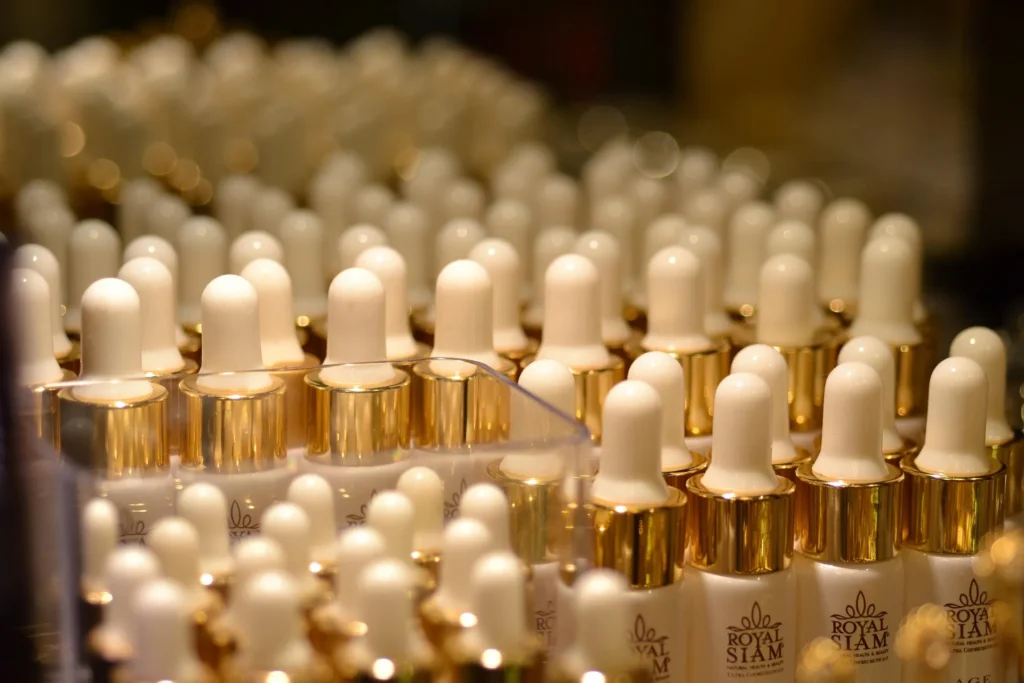
Packaging is one of the most significant and least discussed drivers of skincare prices. A glass bottle with a gold-tipped dropper costs dramatically more to produce than a plastic pump. Some of this expense is purely aesthetic — it has no impact on the product inside. But some packaging choices genuinely matter for efficacy: vitamin C oxidizes in air and light, so an opaque or airless container can preserve its potency in ways that an open jar cannot. Retinol degrades similarly.
When you’re paying a premium for packaging, it’s worth asking: is this protecting the ingredients, or just looking beautiful on my shelf?
Marketing, Branding, and Retail Markup
This is where a significant portion of luxury skincare budgets actually go. A brand that runs full-page ads in Vogue, sponsors major fashion events, and sells through high-end department stores has enormous overhead that gets built into the product price. A brand that sells exclusively direct-to-consumer online, with minimal advertising, can put far more of its budget into what’s inside the bottle.
Retail markup is a particular factor in prestige skincare. Department stores typically take a 50% margin on beauty products. When a product sells for $180 at a department store counter, $90 of that is going to the retailer before a cent is spent on the formula.
The Scent Premium
Fragrance is one of the most expensive ingredients in skincare — and also one of the most potentially problematic. Many luxury skincare products smell extraordinary, and that scent is a significant part of the experience and the price. But fragrance (both synthetic and natural) is a leading cause of contact dermatitis and skin sensitization. If you’re paying a premium for a product that smells like a Parisian garden, you may also be paying a premium for an ingredient that undermines the very results you’re seeking.
What the Science Actually Says
The skincare industry is, to put it politely, loosely regulated when it comes to efficacy claims. Terms like “clinically proven,” “dermatologist-tested,” and “scientifically advanced” have no standardized legal definitions in most markets. A product can be “dermatologist-tested” if a single dermatologist tried it once — and didn’t hate it.
This means that price alone is not a reliable proxy for efficacy, and brand claims should always be approached with skepticism. What does independent research — conducted without industry funding — actually tell us?
Ingredients That Work Regardless of Price
Certain active ingredients have such robust clinical evidence behind them that the key question is not which brand you buy, but whether the product contains an effective concentration. These include:
Retinoids (Retinol, Tretinoin, Retinal): Arguably the most evidence-backed anti-aging ingredient in existence. Tretinoin — available by prescription — has decades of peer-reviewed research demonstrating its ability to increase cell turnover, stimulate collagen production, and reduce the appearance of fine lines, wrinkles, and hyperpigmentation. Drugstore retinol, when formulated at an appropriate concentration and stored correctly, delivers real results. The key variable is concentration and formulation stability, not brand prestige.
Niacinamide: This water-soluble form of vitamin B3 has strong evidence for reducing hyperpigmentation, minimizing pore appearance, strengthening the skin barrier, and reducing redness. It’s also inexpensive to manufacture, which is why you’ll find high-quality niacinamide products at every price point. The Ordinary’s 10% Niacinamide + Zinc serum, which costs a few dollars, has performance data comparable to far more expensive formulations.
Vitamin C (L-Ascorbic Acid): Effective, but tricky to formulate correctly. Requires a low pH (around 3.5) to penetrate the skin, and oxidizes rapidly once exposed to air and light. A well-formulated budget vitamin C can outperform a poorly-formulated luxury one. The key things to look for: L-ascorbic acid on the ingredient list, a concentration between 10-20%, opaque or airless packaging, and a low pH formulation.
Hyaluronic Acid: One of the most overhyped ingredients in skincare. Hyaluronic acid is a humectant — it draws water to the skin — and it works well for this purpose regardless of brand. Paying $180 for a hyaluronic acid serum is, in most cases, paying for everything around the hyaluronic acid, not the molecule itself. Budget versions perform essentially identically.
SPF/Sunscreen: This is the single most evidence-supported skincare intervention available, and also the one where price matters least. A drugstore SPF 30 or SPF 50 broad-spectrum sunscreen provides the same UV protection as a luxury version at ten times the price. The formulation may feel different on the skin, but the protection is standardized by regulation. If price is the barrier between you and daily sun protection, the cheap version is the right choice, every time.
AHAs and BHAs (Glycolic Acid, Salicylic Acid, Lactic Acid): Chemical exfoliants that improve skin texture, unclog pores, and promote cell turnover. The effective concentration range is well established, and budget formulations from brands like Paula’s Choice, The Ordinary, and even basic drugstore brands can be highly effective. Paula’s Choice, it should be noted, sits at a mid-range price point and consistently outperforms much more expensive competitors in independent reviews.
Where Price Actually Matters
Having said all of that, there are genuine categories where paying more can deliver meaningfully better results.
Prescription Retinoids
The most dramatic jump in retinoid efficacy doesn’t come from expensive over-the-counter products — it comes from prescription-strength tretinoin, which is simply more effective than any over-the-counter retinol at equivalent concentrations. In many countries, tretinoin is actually quite affordable, especially through online prescription services. This is a case where “more expensive than drugstore” is justified by genuine clinical superiority, but where the premium luxury retinol cream in the fancy jar rarely outperforms a well-formulated mid-range option.
Peptide Formulations
Peptides are short chains of amino acids that can signal the skin to produce more collagen, improve elasticity, and reduce the appearance of lines. They are also genuinely expensive ingredients to source and stabilize correctly. There’s a meaningful quality difference between a properly formulated peptide serum from a brand that has invested in the chemistry and a budget product that lists peptides on the label but at concentrations too low to be biologically meaningful. This is one of the categories where paying mid-to-high range can be justified.
Stability-Sensitive Formulations
Any active ingredient that degrades rapidly — vitamin C, retinol, certain growth factors — benefits from investment in high-quality packaging and formulation chemistry. A well-packaged, pH-optimized vitamin C serum from a reputable brand may deliver meaningfully better results than a cheap version that oxidizes before you’ve finished the bottle.
Sunscreens for Daily Wear Compliance
Here’s the paradox of sunscreen: the protection level is regulated and doesn’t vary with price, but the texture, feel, and cosmetic elegance of the formula absolutely does. And if a sunscreen feels greasy, leaves a white cast, or sits unpleasantly under makeup, you won’t wear it consistently. A more expensive sunscreen that you apply every day is worth more than a cheap one you avoid. Korean and Japanese sunscreens, which tend to use more elegant newer UV filter technology, often represent excellent value at mid-range prices.
Prescription Treatments for Specific Conditions
For acne, rosacea, melasma, and other specific skin conditions, prescription treatments prescribed by a dermatologist consistently outperform over-the-counter alternatives regardless of price. No amount of money spent on luxury skincare will match the efficacy of prescription azelaic acid for rosacea, or adapalene for acne. If you have a specific skin condition, a consultation with a dermatologist is one of the highest-return investments you can make in your skin.
The Ingredient Label: Your Most Powerful Tool
The single most useful skill you can develop as a skincare consumer is the ability to read an ingredient list. Ingredients in cosmetics are listed in descending order of concentration — what’s listed first makes up the largest proportion of the product, and what’s listed last makes up the smallest.
This means that a product that lists its hero ingredient — say, retinol or niacinamide — near the bottom of a long list may contain so little of it that it’s essentially irrelevant to the product’s performance. This is sometimes called “fairy-dusting”: the practice of listing an impressive-sounding ingredient in a quantity too small to have any effect, purely for marketing purposes.
What to Look for in a Good Formula
When evaluating any skincare product, regardless of price, look for:
- Active ingredients listed in the first half of the ingredient list (or at concentrations specified on the packaging)
- A short, purposeful ingredient list without unnecessary fillers, heavy fragrances, or potentially sensitizing additives
- Packaging appropriate to the formulation — opaque containers for vitamin C and retinol, airless pumps for oxidation-sensitive formulas
- A clear indication of concentration where relevant — “10% niacinamide” tells you far more than just “niacinamide”
- Third-party testing or clinical data from independent labs, not just in-house studies
Red Flags in Any Price Range
Watch out for these regardless of whether you’re buying at a drugstore or a department store:
- Fragrance listed high on the ingredient list — particularly concerning for sensitive skin
- Alcohol denat (denatured alcohol) as a primary ingredient — drying and potentially damaging to the skin barrier with prolonged use
- Mineral oil or petrolatum as primary ingredients in anti-aging products — while these are effective occlusives and perfectly safe, they do nothing for skin biology that a cheap petroleum jelly can’t do
- Claims of “collagen-boosting” creams — topical collagen molecules are too large to penetrate the skin, so the claim is largely meaningless
- “Natural” or “organic” as quality indicators — natural ingredients can be highly sensitizing, and synthetic ingredients can be extremely safe and effective. Naturalistic framing in marketing has no relation to efficacy or safety
A Practical Guide: Where to Spend and Where to Save
Based on the evidence, here is a practical framework for allocating your skincare budget.
Save Without Guilt
Sunscreen. The most important product in any skincare routine, and one where price has no bearing on the core benefit. Find one with a texture you enjoy wearing daily and stick with it.
Hyaluronic acid serums. The molecule is inexpensive, and budget formulations work essentially as well as prestige ones. CeraVe, Neutrogena, and The Ordinary all offer excellent options at low prices.
Basic moisturizers. A well-formulated drugstore moisturizer with ceramides, glycerin, and/or petrolatum is an excellent choice for most skin types. CeraVe, Vanicream, and La Roche-Posay offer dermatologist-recommended formulas at accessible prices.
Niacinamide. One of the most effective and best-studied skincare ingredients, and cheap to manufacture. The Ordinary’s 10% niacinamide serum performs well in independent comparisons with products at many times the price.
Gentle cleansers. Cleanser stays on your skin for approximately 30 seconds before being rinsed off. This is not the place to invest in complex actives. A gentle, fragrance-free cleanser at any price point is all you need.
Basic AHA/BHA exfoliants. Glycolic acid and salicylic acid are well-understood, inexpensive ingredients. Budget formulations at appropriate concentrations perform comparably to expensive ones.
Worth Investing In
A well-formulated vitamin C serum. Given the stability challenges, a trusted brand with good reviews and appropriate packaging is worth paying more for. Skinceuticals CE Ferulic is the gold standard in clinical research (and priced accordingly), but mid-range alternatives like Timeless, Paula’s Choice, and Drunk Elephant have strong track records at more accessible prices.
Prescription retinoids. Not “expensive” in the luxury sense, but requiring a dermatologist consultation. Tretinoin is categorically more effective than over-the-counter retinol for most users, and the investment in a prescription is well justified.
Sunscreen for daily compliance. If the texture of your current sunscreen is preventing you from wearing it, this is worth investing in. A Japanese or Korean sunscreen with a cosmetically elegant finish, even at a higher price, pays dividends in actual use.
Targeted treatments for specific concerns. If you’re dealing with active acne, melasma, or rosacea, a dermatologist appointment is worth far more than any product purchase. Prescription treatments have clinical evidence that no over-the-counter product can match.
The Mid-Range Sweet Spot
For many categories — especially serums, eye creams, and treatment products — the sweet spot is often a mid-range brand that has invested in formulation quality without the overhead of luxury marketing and retail markup. Brands like Paula’s Choice, The Inkey List, Neutrogena’s clinical line, La Roche-Posay, and some CeraVe products consistently over-deliver for their price point.
The Psychology of Expensive Skincare
There’s one factor in this debate that doesn’t get discussed enough: the placebo effect is real, and it matters in skincare.
Studies have repeatedly shown that people report better skin outcomes from products they believe to be high-quality, expensive, or prestigious — even when the formulations are identical to cheaper alternatives. The sensory experience of a product (its scent, its texture, the weight of the jar, the ritual of application) influences how we perceive its effectiveness.
This doesn’t mean expensive skincare is a scam. It means that the experience of a skincare routine has genuine psychological value, and that value is part of what some people are purchasing. If the ritual of applying a beautifully packaged cream from a prestigious brand makes you feel good, makes you more consistent in your routine, and contributes to your sense of self-care — that has real worth.
The problem arises when marketing convinces you that the expensive product is doing things biologically that the science doesn’t support. Paying more for a sensory experience you enjoy is a reasonable choice. Paying more because you’ve been told the product has properties it doesn’t have is being misled.
The Ingredient Categories That Are Genuinely Worth Watching
As the skincare science continues to evolve, a few newer categories show genuine promise and may justify mid-to-high price points as research matures.
Bakuchiol: A plant-derived retinol alternative that has shown genuine efficacy in clinical trials for reducing wrinkles and improving skin tone, with better tolerability than retinol for sensitive skin types. Still more expensive than retinol, but supported by real data.
Growth Factors: EGF (epidermal growth factor) and similar peptides show promise for skin renewal. The research is still developing, but growth factor serums from brands like SkinMedica and iS Clinical have more clinical backing than most luxury products.
Tranexamic Acid: A relative newcomer to skincare that shows strong evidence for treating hyperpigmentation, potentially rivaling or exceeding kojic acid and azelaic acid for certain users. Not yet widely available at budget price points, but worth watching.
Barrier-Repairing Ceramide Complexes: While ceramides are available at all price points, more complex multi-ceramide formulations from brands like Dr. Jart+ and SkinCeuticals have meaningful evidence for repairing compromised skin barriers in a way that single-ceramide formulations may not fully replicate.
Building the Best Routine for Your Budget
Whatever your budget, the most effective skincare routine is the one you actually do, consistently, every day. The research on skincare efficacy is unanimous on one point: consistency matters more than any individual product.
A $200 serum used sporadically will not outperform a $15 moisturizer used every single day. A perfect ten-step luxury routine that you abandon after two weeks will not produce results. The psychology of commitment and habit is a more powerful force in skincare outcomes than the marginal differences between formulations at different price points.
The non-negotiable basics at any budget:
- A gentle cleanser — twice daily, morning and night
- A broad-spectrum SPF 30 or higher — every single morning, rain or shine, indoors or outdoors
- A moisturizer appropriate for your skin type — to maintain and support the skin barrier
- One or two targeted actives — chosen based on your specific skin concerns (retinol for aging, niacinamide for tone and texture, vitamin C for brightness and photoprotection, salicylic acid for acne)
That’s it. You do not need a ten-product routine to have excellent skin. Many dermatologists with exceptional skin use three or four products, consistently, for years.
The Verdict: Is Expensive Skincare Worth It?
Sometimes — but less often than the industry wants you to believe.
The honest summary is this: the most important skincare ingredients are available at every price point. Consistency and sun protection matter more than any specific product. Some premium formulations genuinely deliver better results through superior concentration, packaging, or proprietary delivery technology — but many expensive products are expensive primarily because of branding, marketing, and retail infrastructure.
The smartest skincare consumers don’t shop by brand prestige or by price. They read ingredient lists. They follow the evidence. They invest in prescriptions when needed. They save on the basics and spend selectively on the products where formulation quality genuinely makes a difference.
Your skin doesn’t know what you paid. It responds to what you actually put on it, how consistently you do it, and whether you protect it from the sun. Get those fundamentals right — at any price — and you’ll be ahead of most of the beauty industry’s marketing.
Quick Reference: Cheap vs Expensive by Product Type
| Product | Save or Spend? | Why |
|---|---|---|
| Sunscreen | Save | Protection is regulated; price doesn’t affect SPF |
| Basic moisturizer | Save | Ceramides and glycerin work regardless of brand |
| Hyaluronic acid serum | Save | Inexpensive molecule; budget versions perform identically |
| Niacinamide | Save | Cheap to manufacture; budget brands rival luxury brands |
| Gentle cleanser | Save | On skin 30 seconds; actives are wasted here |
| Vitamin C serum | Mid-range | Stability matters; invest in packaging and formulation |
| Retinol serum | Mid-range | Concentration and stability matter; prescription is best value |
| Peptide serums | Mid-range to spend | Expensive to formulate correctly; cheap versions often underdosed |
| Exfoliants (AHA/BHA) | Save | Well-understood actives; budget versions work well |
| Eye cream | Skepticism warranted | Often the same as a face moisturizer in smaller packaging |
| SPF moisturizer hybrid | Mid-range | Texture matters for compliance; worth finding one you love |
| Prescription tretinoin | Spend (via Rx) | Categorically more effective than any OTC retinol |
The best skin of your life won’t come from the most expensive products. It will come from understanding what your skin actually needs, finding formulations that deliver those ingredients reliably, wearing sunscreen every day without fail, and giving your routine the time it needs to work. That combination beats any luxury brand, at any price.
About the Author
Ana Milojevik is a shopping writer and consumer content contributor at Shoopilyd.com, where she writes about online shopping, product research, e-commerce, price comparisons, and consumer advice. Her goal is to provide practical, trustworthy information that helps readers compare options, shop safely, and make more informed purchasing decisions.