AI Shopping Assistants: How AI Is Changing the Way We Shop Online in 2026
AI shopping assistants are changing how people discover, compare, and buy products online in 2026. Learn how agentic commerce works, what retailers are doing to adapt, and why human-controlled checkout still matters.

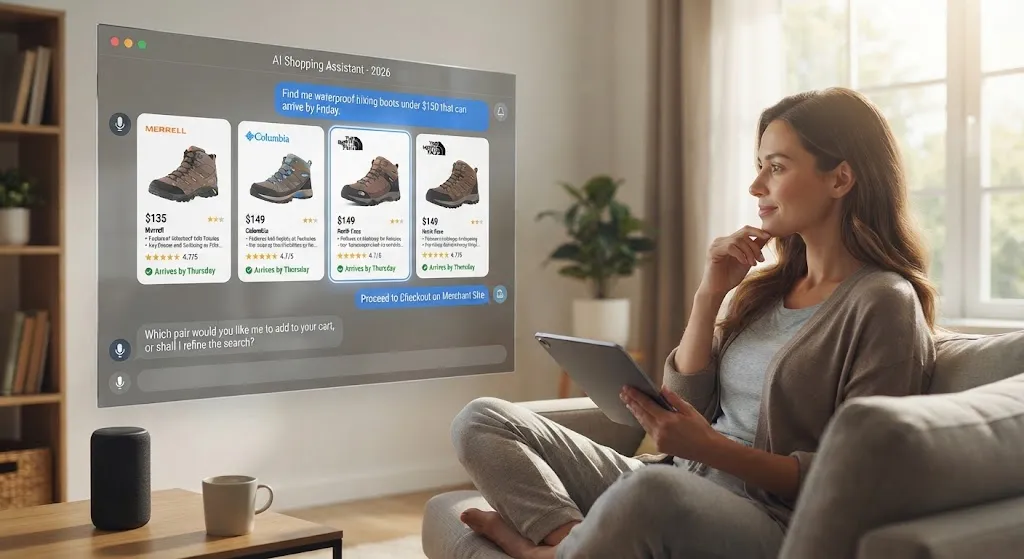
Shoppers increasingly use AI shopping assistants to discover and compare products through natural conversation and personalized recommendations.
Online shopping used to mean opening a dozen browser tabs, comparing prices across sites, scrolling through hundreds of reviews, and hoping the item you picked actually fit the description. In 2026, a growing number of shoppers are skipping most of that. Instead, they’re typing a single sentence into an AI assistant — “find me waterproof hiking boots under $150 that can arrive by Friday” — and letting the software do the legwork.
This shift has a name: agentic commerce. And whether or not you’ve used it yet, it’s already reshaping how products are discovered, compared, and bought online.
Here’s what’s actually happening, what’s still more hype than reality, and what it means for how you’ll shop next.
What Are AI Shopping Assistants, Exactly?
AI shopping assistants are conversational tools — built into apps like ChatGPT, Amazon’s Rufus, Perplexity, and a growing list of retailer-specific bots — that help shoppers find and choose products through natural conversation instead of traditional search and category pages.
It helps to separate two very different levels of capability:
- Basic chatbots answer questions using scripted logic. Ask one “do you have running shoes?” and it’ll say yes or no.
- True AI shopping agents interpret intent and take action. Ask an agent the same question, and it will figure out what you actually need the shoes for, pull relevant options from a catalog, and guide you toward a purchase — sometimes completing the transaction itself.
That second category is what’s generating so much attention in 2026. These systems don’t just retrieve information; they reason through goals, compare options across multiple retailers, and in some cases execute a purchase with little or no further input from the shopper.
The Numbers Behind the Shift
The scale of this change is no longer speculative — it shows up in retailer data. A few figures stand out:
- OpenAI’s ChatGPT was reportedly processing around 50 million shopping-related queries a day as of early 2026.
- Amazon’s Rufus assistant has been used by an estimated 300 million customers.
- Shopify merchants saw AI-referred orders grow by roughly 13 times year-over-year in the first quarter of 2026.
- During Cyber Week 2025, AI-driven shopping interactions were linked to an estimated $67 billion in global online sales — about a fifth of all digital orders, according to Salesforce’s holiday shopping data. Three years earlier, that number was close to zero.
Surveys back up what the transaction data suggests. Industry research this year has found that a large majority of consumers — commonly cited around 70% — now use AI in some part of their shopping journey, most often for generating product ideas, summarizing reviews, and comparing prices. Far fewer have completed an actual purchase through an AI referral so far, but a majority say they’re at least somewhat comfortable letting an agent buy something on their behalf under the right conditions.
Longer-term forecasts are even more aggressive. Morgan Stanley has projected that nearly half of online shoppers could be using AI shopping agents by 2030, representing roughly a quarter of their total spending. J.P. Morgan’s estimate lands in a similar range, projecting agentic commerce could account for up to a quarter of U.S. online sales by the end of the decade, concentrated heavily in recurring, low-risk purchases like groceries and subscriptions. McKinsey has floated a figure as high as $3 trillion to $5 trillion in annual agentic commerce activity worldwide by 2030.
The Retail Industry’s Scramble to Keep Up
Every major player in e-commerce has entered this race in some form. Amazon expanded Rufus with automatic-purchasing capability. OpenAI built checkout functionality directly into ChatGPT. Perplexity launched its own AI-powered browser and a free conversational shopping experience — a move that drew legal pushback from Amazon over how the browser accessed its site.
Payment infrastructure has followed close behind. Stripe launched an Agentic Commerce Suite at the end of 2025 that lets merchants sell through any compatible AI agent, and a growing list of retail brands — including Coach, Kate Spade, Revolve, Vuori, Ashley Furniture, and the URBN family of stores (Anthropologie, Free People, Urban Outfitters) — have plugged into it. Etsy became the first major marketplace to integrate a similar protocol and is now reportedly the largest source of handmade and vintage inventory that shows up inside ChatGPT’s shopping results.
Grocery delivery has emerged as its own front in this shift. DoorDash has expanded its ChatGPT integration beyond groceries into other local commerce categories, and grocery chain Albertsons is reportedly building a proprietary AI shopping assistant aimed at cutting the average time a customer spends shopping from roughly 46 minutes down to just 4.
Why Checkout Didn’t Go Fully Autonomous

Here’s the part that’s surprised a lot of industry watchers: full, hands-off autonomous checkout — where an agent completes a purchase entirely on its own, no human confirmation required — hasn’t taken off the way many expected heading into 2026.
Discovery and comparison shifted to AI assistants quickly. But the actual transaction has largely stayed with merchants. ChatGPT, for instance, scaled back some of its direct in-app checkout functionality and moved back toward routing shoppers to conventional merchant websites to finish a purchase. Other agentic-commerce protocols continued developing in the background, but the pattern has held: for now, retailers still control the transaction — and with it, the delivery promise that comes after a sale.
That distinction matters for a simple reason: trust. Consumers appear comfortable letting an AI narrow their options and make a recommendation. Handing over full purchasing authority, including a stored payment method, is a bigger leap for most people, and adoption is climbing more gradually as a result.
What This Means If You’re Shopping Online Right Now
For everyday shoppers, the practical changes are already visible even if you’ve never deliberately used an “AI shopping agent”:
Product discovery increasingly starts outside of Google. Instead of typing a keyword into a search bar and clicking through category pages, more shoppers are describing what they want in plain language and letting an assistant surface options from multiple retailers at once.
Comparisons happen faster, but double-checking still helps. Assistants are good at summarizing reviews, comparing specs, and narrowing a field of options. They’re not infallible — pricing, stock levels, and shipping estimates can be out of date, so a quick manual check before you buy is still worth the extra minute.
Checkout is still mostly in your hands. Despite the “agent buys it for you” narrative, most purchases in 2026 still end with a human clicking the final “buy” button on a retailer’s own site, even if an AI assistant did the research.
Retailers are optimizing for AI visibility, not just search rankings. Just as brands once obsessed over search engine optimization, a new discipline — sometimes called answer engine optimization — has emerged, focused on making sure a store’s products are structured in a way that AI assistants can read, compare, and recommend.
What to Watch For Next
A few developments look likely to shape the next stage of this shift:
- Wider adoption in low-risk categories. Analysts expect agentic commerce to take hold fastest in recurring purchases like groceries, household staples, and subscriptions — items where the stakes of an AI making a small mistake are low.
- More retailers plugging into agent-compatible payment systems. Expect the current list of Stripe- and protocol-integrated retailers to keep expanding across apparel, home goods, and electronics.
- A slower climb toward full autonomous purchasing. Given how quickly checkout responsibilities snapped back to merchants this year, expect the “AI buys it entirely on its own” vision to keep arriving gradually rather than all at once — gated by consumer comfort, fraud protections, and how reliably agents handle edge cases like out-of-stock items or last-minute price changes.
The Bottom Line
AI hasn’t replaced online shopping — at least not yet. What it has done is compress the discovery and comparison phase of shopping into a conversation, while leaving the final purchase decision largely in human hands. That middle ground, sometimes called the “agentic inversion,” looks like it will define online shopping for the next several years: assistants doing the browsing, humans still doing the buying.
Whether that balance shifts further toward full automation will depend less on what the technology can do and more on how comfortable shoppers become handing over the last step. Based on how 2026 has played out so far, that comfort is growing — just not as fast as the industry originally expected.
Have you used an AI shopping assistant to research or buy something recently? The tools are evolving quickly, and how consumers respond will likely shape how much control retailers and platforms are willing to hand over next.





1 thought on “AI Shopping Assistants: How AI Is Changing the Way We Shop Online in 2026”