Best Price Comparison Websites for Online Shopping
Discover the best price comparison websites and shopping tools to compare prices, track discounts, find coupons, and make smarter online buying decisions.
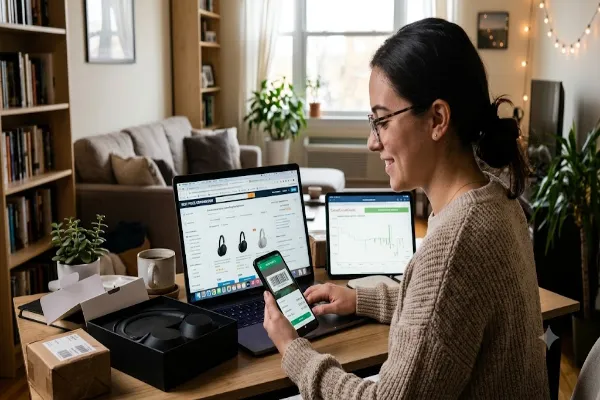
A consumer uses a multi-device approach—smartphone, laptop, and tablet—to actively track price history and scan for deals on new electronics.
Online shopping has made it easier than ever to buy almost anything, but it’s also created a new challenge: with thousands of retailers selling the same products, how do you know you’re actually getting the best price? That’s where price comparison websites come in. These tools pull pricing data from multiple retailers into one place, so instead of opening a dozen browser tabs, you can see where a product is cheapest in just a few seconds.
In this guide, we’ll walk through the best price comparison websites and tools available today, what makes each one useful, and how to choose the right one for the way you actually shop.

What Is a Price Comparison Website?
A price comparison website, sometimes called a comparison shopping engine or shopbot, gathers product listings, prices, and often reviews from multiple online retailers and displays them together. Instead of searching each retailer individually, you search once, and the site shows you which stores carry the product and what it costs at each one.
Some tools go further than simple price listings. Certain platforms track historical pricing over time, so you can see whether today’s price is actually a good deal or just a temporary markup dressed up as a “sale.” Others work as browser extensions that automatically hunt for coupon codes at checkout, or apps that let you scan a barcode in a physical store to check if the same item is cheaper online.
| Tool | Best For | Free | Price History | Coupons | Cashback |
|---|---|---|---|---|---|
| Google Shopping | Comparing retailers | ✓ | No | No | No |
| CamelCamelCamel | Amazon | ✓ | ✓ | No | No |
| Honey | Coupon codes | ✓ | Limited | ✓ | No |
| Capital One Shopping | Automatic savings | ✓ | Limited | ✓ | Rewards |
| Rakuten | Cashback | ✓ | No | No | ✓ |
Why Use a Price Comparison Site?
Retail prices fluctuate constantly. Major retailers change prices on products extremely frequently, sometimes multiple times within the same day, depending on demand, competitor pricing, and inventory levels. Without some kind of tracking or comparison tool, it’s genuinely difficult to know whether a price you’re looking at is a fair one.
Comparison shopping tools solve this by giving you visibility into:
- Which retailers currently sell a given product
- How prices compare across those retailers, including shipping costs
- Whether the current price is higher or lower than recent historical prices
- Available coupon codes or cashback offers that can lower the final price further
Used consistently, these tools can save shoppers a meaningful amount of money over the course of a year, particularly on bigger purchases like electronics, appliances, and furniture.
Our Top Recommendations
- Best Overall: Google Shopping
- Best for Amazon: CamelCamelCamel
- Best for Coupons: Honey
- Best Cashback: Rakuten
- Best for Europe: Idealo
Imagine you’re buying Apple AirPods. Google Shopping shows prices from several retailers, CamelCamelCamel lets you see whether Amazon’s current price is actually a discount, and Honey automatically tests coupon codes before checkout.
The Best Price Comparison Websites and Tools
- Google Shopping
Google Shopping remains one of the most widely used price comparison tools simply because of its scale. It searches across thousands of retailers and displays prices, product ratings, shipping options, and seller policies side by side.
Strengths: Massive retailer coverage, live pricing, useful filters for free shipping, returns, and product condition.
Watch out for: Sponsored listings are mixed in with organic results, so it’s worth double-checking the final price at checkout rather than assuming the listed price is guaranteed. It also includes a large number of third-party marketplace sellers, which can add some noise to the results.
Best for: Shoppers who already know the specific product or model they want and just need to find the best current price.
- CamelCamelCamel
If most of your shopping happens on Amazon, CamelCamelCamel is one of the most useful tools available. Rather than comparing prices across different retailers, it tracks the price history of individual Amazon products over time, showing you graphs of how the price has moved over weeks, months, or even years.
Strengths: Completely free, highly accurate for Amazon-specific pricing, and includes a browser extension that can alert you the moment a tracked product drops in price.
Watch out for: It only covers Amazon, so it won’t tell you if a competing retailer like Walmart or Best Buy has the item cheaper.
Best for: Amazon shoppers who want to time a purchase around a genuine price drop rather than a marketing gimmick.
- Bizrate
Bizrate has been around for a long time and functions similarly to a search engine specifically built for shopping. You enter a product or category, and it returns a list of retailers along with pricing, allowing you to sort by best match, lowest price, or filter for deals like free shipping.
Strengths: Straightforward to use, includes verified buyer reviews alongside pricing, and lets you set up price drop alerts by simply entering your email and a target price.
Watch out for: The interface feels a bit dated compared to newer tools, though it still gets the job done.
Best for: Shoppers who want pricing data paired with merchant reliability reviews before committing to a purchase.
- PriceRunner
PriceRunner, now part of Klarna, is a free-to-use price comparison engine that’s particularly strong for shoppers in the UK and parts of Europe. It compares prices across a wide range of retailers and product categories, from electronics to home goods.
Strengths: Clean interface, strong regional retailer coverage, and no cost to use.
Watch out for: Coverage and accuracy can vary depending on your country, so results may be stronger in some markets than others.
Best for: UK and European shoppers looking for a straightforward, no-frills price comparison tool.
- Idealo
Idealo is one of the most visited price comparison platforms globally, particularly popular across Europe. It aggregates listings from a wide range of retailers and includes detailed product specifications alongside pricing, which makes it useful for comparing similar products, not just the same product across different sellers.
Strengths: Very high user engagement and traffic, detailed product comparisons, and broad category coverage.
Watch out for: As with most comparison engines, sponsored placements can appear alongside organic listings.
Best for: Shoppers who want to compare similar products, not just prices for the exact same item, particularly in European markets.
- Capital One Shopping
Capital One Shopping (formerly known as Wikibuy) is a free browser extension and mobile app, not a traditional comparison website. It works quietly in the background while you shop, automatically checking whether the same product is available at a lower price from a competing retailer, and testing available coupon codes at checkout.
Strengths: No Capital One account or credit card required to use it, works across tens of thousands of retail sites, and requires no manual searching since it runs automatically during checkout.
Watch out for: It works passively, so it’s a helpful supplement rather than a primary tool for actively researching and comparing products before you shop.
Best for: Shoppers who want an automatic, low-effort way to catch better prices and coupon codes without changing their normal shopping habits.
- Honey (PayPal Honey)
Honey is another free browser extension, acquired by PayPal, that automatically searches for and applies coupon codes at checkout across a large number of online retailers. It also allows you to build a wish list of products to track, notifying you when prices drop.
Strengths: Extremely easy to set up, works automatically at checkout, and covers thousands of retailers.
Watch out for: Honey is focused primarily on coupon codes and deal alerts rather than being a full price comparison engine across multiple retailers.
Best for: Shoppers who want an effortless way to make sure they’re not missing an available discount code at checkout.
- ShopSavvy
ShopSavvy is a mobile-first price comparison app designed for on-the-go shopping. It allows you to search by keyword, scan a barcode, or enter a UPC code to instantly see prices for that product both online and at nearby physical retailers.
Strengths: Fast barcode scanning, useful for real-time in-store comparisons, and a large existing user base.
Watch out for: Coverage can shrink for niche or less mainstream products, and it works best for mass-market electronics and everyday consumer goods.
Best for: Shoppers standing in a physical store who want to quickly check whether the same item is cheaper online.
- Yahoo Shopping
Yahoo Shopping combines price comparison with deal discovery, allowing shoppers to build a wish list of products and track price changes over time, while also surfacing current deals and discounts across categories.
Strengths: High overall traffic and a simple, familiar interface for anyone who has used Yahoo’s other products.
Watch out for: Retailer coverage may not be as deep in every category compared to more specialized comparison engines.
Best for: Shoppers who want basic price tracking combined with general deal browsing in one place.
- Rakuten
Rakuten operates a bit differently from a traditional comparison engine. Rather than only showing you prices across retailers, it focuses on cashback: when you shop through Rakuten’s links at partner retailers, you earn a percentage of your purchase back, on top of whatever price you already paid.
Strengths: Genuine cash-back earnings on everyday purchases, works with a large number of major retailers, and payouts are made directly to your PayPal account or by check.
Watch out for: It’s not designed to compare prices across multiple retailers for the same product; it’s better thought of as a rewards layer on top of shopping you were already planning to do.
Best for: Shoppers who want to earn money back automatically on purchases at retailers they already use regularly.
- Slickdeals
Slickdeals is a community-driven deal aggregator rather than a strict price comparison engine. Registered members submit deals they’ve found, and the community votes on which ones are genuinely good, effectively crowdsourcing deal discovery across a huge range of categories.
Strengths: Highly active community, strong coverage of tech and electronics deals, and deals are vetted by real shoppers rather than automated systems alone.
Watch out for: Because it’s community-submitted, deal quality and relevance can vary, and it works best as a discovery tool rather than a direct price-comparison lookup for a specific product.
Best for: Deal hunters who enjoy browsing for bargains rather than searching for one specific item.
A Note on AI-Powered Shopping Assistants

A newer category of tools has emerged that goes beyond simple price comparison. Rather than just listing prices across retailers, AI-powered shopping assistants can read product reviews, compare specifications, weigh price against overall quality, and return a curated recommendation based on your budget and needs, all within a single conversation.
This approach is particularly useful for the common “what should I buy?” question, as opposed to the “where’s it cheapest?” question that traditional comparison engines are built to answer. For shoppers who already know the exact product they want, a traditional price comparison site is usually still the faster and more direct option. For open-ended research and buying decisions, AI shopping tools are becoming an increasingly popular complement to traditional comparison shopping.
How to Choose the Right Price Comparison Tool for You
With so many options available, the right choice really depends on how you shop:
If you shop mostly on Amazon, a dedicated Amazon price tracker is likely more useful than a general comparison engine, since it will give you a clearer picture of genuine price history for that specific platform.
If you’re comparing prices across many different retailers for a specific product, a broad comparison engine with wide retailer coverage is usually the better starting point.
If you want a low-effort way to catch coupon codes and better prices without changing how you shop, a passive browser extension that works automatically at checkout is worth adding, even alongside another tool.
If you enjoy discovering deals rather than searching for a specific item, a community-driven deal aggregator can surface bargains you wouldn’t have found through search alone.
Many experienced deal-hunters don’t rely on just one tool. Instead, they combine two or three of these platforms, using one for browsing prices, one for tracking historical data, and one for automatically applying coupons at checkout, to cover every stage of the buying decision.
Tips for Getting the Most Out of Price Comparison Sites
Always check the final checkout price. Listed prices on comparison sites don’t always include shipping, taxes, or other fees, so the final number can sometimes differ from what’s initially displayed.
Look at price history, not just the current price. A “sale” price is only meaningful if it’s genuinely lower than what the product has historically sold for, which is exactly what dedicated price-tracking tools are built to show you.
Combine tools rather than relying on just one. Using a price tracker alongside a coupon-finding browser extension, for example, can help you both find the best base price and reduce it further.
Set alerts for big purchases. If you’re not in a rush, setting a price-drop alert on a big-ticket item can help you avoid overpaying simply because you happened to check on the wrong day.
Be cautious with unfamiliar third-party sellers. Comparison sites often surface listings from smaller or less well-known marketplace sellers offering lower prices. Before buying, it’s worth quickly checking seller ratings and return policies to make sure the savings are worth any added risk.
Final Thoughts
Price comparison websites have become an essential part of smart online shopping, helping consumers avoid overpaying in a market where prices can change constantly and vary widely between retailers. Whether you rely on a broad comparison engine like Google Shopping, a specialized tool like CamelCamelCamel for Amazon price tracking, or a passive browser extension like Capital One Shopping or Honey that works quietly in the background, the right combination of tools can add up to real, ongoing savings.
Rather than searching for a single perfect tool, the most effective approach is usually to build a small toolkit: one for comparing prices across retailers, one for understanding price history, and one for catching coupon codes and cashback automatically. Used together, these tools take much of the guesswork out of online shopping, helping you buy with confidence that you’re getting a genuinely good deal.
Key Takeaways
- Compare prices before purchasing.
- Check historical prices, not just current discounts.
- Combine comparison tools with coupon and cashback apps.
- Verify seller reputation before ordering.
FAQ
What is a price comparison website?
A price comparison website helps you compare prices from multiple online retailers, making it easier to find the best deal on a product.
Which is the best price comparison website?
The best option depends on your needs. Google Shopping is great for comparing prices across retailers, while CamelCamelCamel is ideal for tracking Amazon price history.
Are price comparison websites free to use?
Yes, most price comparison websites and browser extensions are free for shoppers.
Do price comparison websites include shipping costs?
Some comparison tools include shipping costs, but it’s always a good idea to check the final price at checkout before making a purchase.
Can price comparison tools help me save money?
Yes. By comparing prices, tracking price history, and finding coupons or cashback offers, these tools can help you save money on online purchases.
Sources
- Google Shopping – https://shopping.google.com/
- CamelCamelCamel – https://camelcamelcamel.com/
- Bizrate – https://www.bizrate.com/
- PriceRunner – https://www.pricerunner.com/
- Idealo – https://www.idealo.com/
- Capital One Shopping – https://capitaloneshopping.com/
- PayPal Honey – https://www.joinhoney.com/
- ShopSavvy – https://shopsavvy.com/
- Yahoo Shopping – https://shopping.yahoo.com/
- Rakuten – https://www.rakuten.com/
- Slickdeals – https://slickdeals.net/
About the Author
Ana Milojevik is a shopping writer and consumer content contributor at Shoopilyd.com, where she writes about online shopping, product research, e-commerce, price comparisons, and consumer advice. Her goal is to provide practical, trustworthy information that helps readers compare options, shop safely, and make more informed purchasing decisions.