Tax-Free Shopping Abroad: How VAT Refunds Work and How to Claim Yours
Learn how VAT refunds work when you shop abroad, who qualifies, and how to claim yours step by step, including the new 2026 rules for Japan and the UK.
TL;DR: Many countries let visitors who live abroad claim back the VAT (sales tax) on goods they take home. To get your money, you need a participating store, the right paperwork, and customs validation before you leave. Rules differ by country, and fees reduce the refund. Japan switched to a “pay now, refund later” system on November 1, 2026, and Great Britain still has no airport refund scheme.
Shopping abroad is one of the best parts of travel, especially in places known for fashion, electronics, cosmetics, and luxury goods. Many travelers don’t realize they may be able to recover part of what they pay in tax.
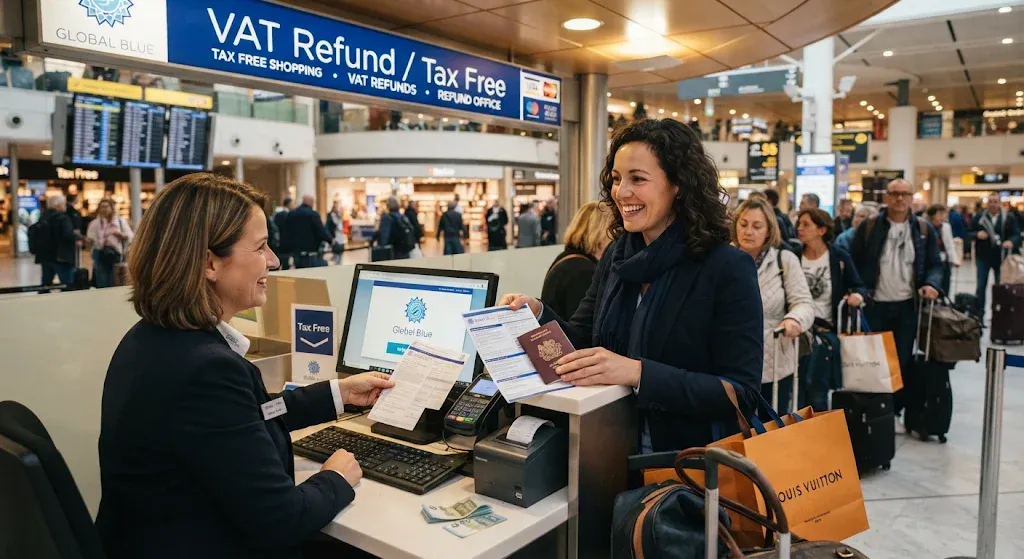
In a lot of countries, visitors who live elsewhere can claim a refund of the Value Added Tax (VAT) included in the price of eligible goods. On expensive items, this can add up to real savings. The process only works if you follow the rules, so here is what you need to know.
What Is Tax-Free Shopping?
Tax-free shopping lets eligible visitors recover the VAT paid on qualifying purchases when they take those goods out of the country.
VAT is a consumption tax built into the price of most goods. You don’t see it as a separate line at the checkout, but it is part of what you pay. On a designer handbag, a watch, or a laptop, a meaningful share of the price is tax.
The idea behind tax-free shopping is simple. Goods bought by visitors and used outside the country shouldn’t be taxed there. How the refund works differs from place to place. Some countries pay you at the airport, some require customs approval first, and some refund the money to your card days or weeks later.
Who Is Eligible for a VAT Refund?
Eligibility usually depends on where you permanently live, not on your nationality.
If you live outside the European Union, for example in Australia, the United States, or Canada, you can generally claim VAT back on qualifying purchases made in EU countries. The main EU conditions are:
- Residence outside the EU: You must normally live outside the EU, and you may need to show your passport as proof.
- Minimum spend: Each country sets its own minimum purchase amount.
- Export of the goods: You must take the items out of the EU within the allowed period.
- Customs validation: Customs must confirm the export, either with a stamp or electronically, before you leave the EU.
- Valid paperwork: You need to keep your original receipts and refund forms or electronic records.
A non-EU passport alone is not a guarantee. Your place of permanent residence and the rules of the country where you shop both matter.
Which Purchases Qualify?
Tax-free schemes are designed for physical goods bought for personal or family use. Commonly eligible items include:
- Clothing, shoes, and accessories
- Designer handbags and luxury goods
- Watches and jewelry
- Smartphones, laptops, and other electronics
- Cosmetics, skincare, and perfume
- Household and decorative items
- Sports equipment and other personal goods
Services generally do not qualify. That means hotels, restaurants, transport, and entertainment tickets are excluded. Goods ordered online and delivered to your home are usually handled under different tax rules, and some countries exclude certain product categories. Before a big purchase, ask the store whether the item qualifies.
How Much Can You Get Back?
The refund depends on the local VAT rate, the value of your purchase, and any fees taken by the store or refund company. Standard VAT rates in several popular European destinations are:
- Germany: 19%
- France: 20%
- Italy: 22%
- Spain: 21%
- Austria: 20%
These are the standard rates, not the percentage of your total you will receive. Some goods have reduced rates, and refund companies deduct service charges.
Here is an example. If you pay €1,000 in a country with 20% VAT, the tax included in that price is about €166.67, not €200. That’s because VAT is already part of the €1,000. After fees, your refund could be lower still. Always ask for the estimated net refund before you pay.
How to Claim Your VAT Refund: Step by Step
Step 1: Shop at a participating store
Look for a “Tax Free” sign in the window or ask the sales assistant. Many department stores, shopping centers, and luxury and electronics retailers take part, but not all of them do.
Step 2: Show your passport and ask for the paperwork
Tell the cashier you want to claim a VAT refund before you pay. You’ll normally need your passport or other accepted ID. The store will prepare a paper form, an electronic record, or a special invoice. Check that your name, passport details, and purchase amount are correct before you leave.
Step 3: Keep your receipts and your goods accessible
Keep all receipts, invoices, and refund forms together. Customs officers may ask to see the items to confirm they are leaving the country. Don’t pack them in checked luggage until you have completed any required inspection. If you have to check them in, ask airport staff what to do first.
Step 4: Get customs validation before you leave
This is the most important step. Depending on the country, you may need to:
- Visit a customs desk at the airport
- Scan your documents at a self-service customs kiosk
- Show your passport, receipts, and goods to an officer
- Complete an electronic export validation
If you have a connecting flight, pay attention to where validation must happen. When leaving the EU, it is usually done at your last departure point from the EU. If you fly from Paris to Frankfurt and then onward to a non-EU country, validate in Frankfurt, not in Paris. Allow extra time at the airport.
Step 5: Request your refund
After validation, follow the instructions from the store or refund operator. Depending on the system, you may be able to:
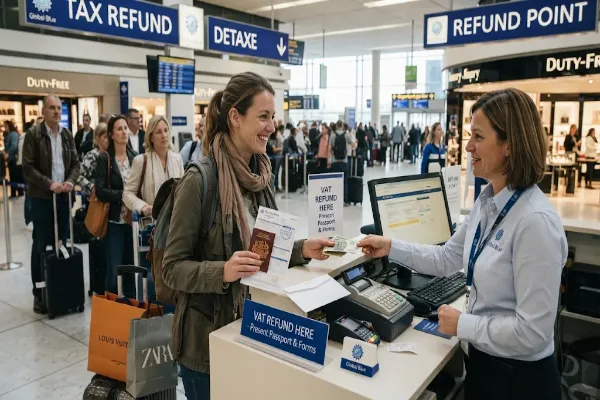
- Collect cash at an airport refund counter
- Receive the refund on your credit or debit card
- Submit the validated document electronically
- Mail the stamped paperwork to the refund company
Card refunds are convenient because you don’t need to carry extra cash. Some refunds arrive quickly, while others take several weeks.
Step 6: Confirm the money arrived
Keep copies of your documents until the refund shows up in your account. If it doesn’t arrive in the expected time, contact the store or refund company using the reference number on your paperwork.
VAT Refund Rules in Different Countries
The basic idea is the same everywhere, but the details differ.
The European Union
The EU has a well-established system for visitors who live outside the bloc. The general rule is that you must show the goods and your refund documents to customs when leaving the EU within three months of purchase. Some countries, such as Germany and France, count those three months from the end of the month in which you bought the item, so check the rules of the country where you shop.
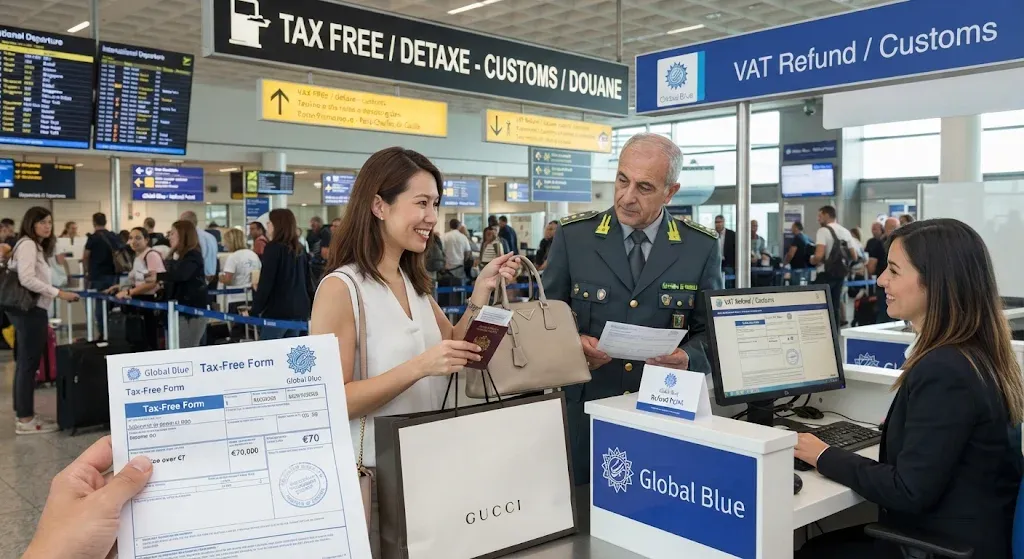
Each country also sets its own minimum spend. In Italy, for example, a single invoice must be above €70 (in practice, €70.01). Refunds are processed either by the store itself or by specialist companies such as Global Blue or Planet.
The United Kingdom
The UK works differently from the EU. In England, Scotland, and Wales (Great Britain), the airport scheme for visitors, known as the VAT Retail Export Scheme, ended on 1 January 2021. Today, tax-free purchases in Great Britain are generally possible only when a store ships your goods directly to an address outside the UK.
Northern Ireland has its own scheme, which still lets eligible visitors who live outside Northern Ireland and the EU claim VAT back on goods they export. It has special rules if you travel from Northern Ireland to Great Britain. So don’t assume you can claim VAT at Heathrow the way you could in Paris or Rome. Politicians have promised to bring the scheme back, but at the time of writing it is not available in Great Britain.
Japan
Japan changed its system on November 1, 2026. Before that date, eligible visitors paid no consumption tax at the register. Now they pay the full tax-inclusive price and get the consumption tax back after customs confirms the goods are leaving Japan. Here is what to know:
- Minimum spend: ¥5,000 before tax, at one store, on one day.
- Deadline: Customs confirmation must be completed within 90 days of purchase.
- Customs step: You usually complete it with your passport at a terminal in the international departure area, and this must be done before you check in your baggage. Keep your tax-free items with you.
- Fees: A refund handling fee is deducted from your refund.
If you’re using an older travel guide that describes tax-free purchases at the checkout, ignore that section. Check the Japan Tourism Agency’s current guidance before you travel.
Common Mistakes That Can Cost You Your Refund
1. Not asking for tax-free paperwork. Some stores won’t prepare it unless you ask before paying.
2. Shopping at a non-participating store. A normal receipt is not enough. Confirm the store can provide the right documents.
3. Skipping customs validation. A completed form isn’t always enough. You may need an official stamp or an electronic confirmation before you depart.
4. Packing your purchases too early. Customs may want to inspect the goods. Keep them accessible until validation is complete.
5. Missing the export deadline. Most programs have a time limit. If you miss it, the purchase may no longer qualify.
6. Making mistakes on your forms. Even a small error in your passport details can cause delays.
7. Ignoring fees. Refund companies may deduct service charges and currency conversion costs, so don’t assume you’ll recover the full VAT.
Tips for Getting the Most From Tax-Free Shopping
- Compare prices first. An item may still be cheaper at home, even after a refund.
- Know the minimum spend. If you’re close to the threshold, check whether you can combine items in one transaction at the same store.
- Choose established retailers. Large department stores and shopping centers often have dedicated tax-free services.
- Keep your documents organized. Store receipts, invoices, and forms together throughout the trip.
- Arrive early at the airport. Customs queues and refund counters can be busy, especially in peak season.
- Check the refund method. Find out whether you’ll be paid in cash, on your card, or in another way.
- Watch currency conversion. If your refund is in a different currency, your bank may charge conversion fees.
One more point: a VAT refund does not exempt you from import duties and taxes when you get home. Your own country’s customs rules and personal allowance still apply, so declare anything above the limit.
Is Tax-Free Shopping Worth It?
For many travelers, yes, especially for expensive items like luxury fashion, jewelry, watches, and electronics. The real benefit depends on the local VAT rate, the minimum spend, fees, currency conversion, and how the price compares with what you’d pay at home.
Time matters too. For a small purchase, the savings may not justify the paperwork and the wait at the airport. For a larger purchase, the difference can be significant.
Frequently Asked Questions
No. Retailers and customs look at your country of permanent residence, and each country sets its own minimum spend and paperwork rules. A non-EU passport is usually the starting point, not a guarantee.
Less than the headline VAT rate suggests. VAT is already included in the price, so on a €1,000 purchase at 20% VAT the tax portion is about €166.67, not €200. Refund companies and retailers may also deduct service fees, so ask for the estimated net refund before you buy.
Physical goods for personal use that you take out of the country, such as clothing, shoes, bags, watches, jewelry, electronics, and cosmetics. Services like hotels, restaurants, transport, and tickets generally do not qualify.
Under the EU’s general rule, you must show the goods to customs on departure within three months of purchase. Some countries count this from the end of the month of purchase, so check the rules for the country where you shop.
At your last departure point from the EU, not necessarily your first airport. If you fly from Paris to Frankfurt and then on to a non-EU country, validation is done in Frankfurt. Allow extra time there.
Not until customs has validated your paperwork, because officers may ask to see the goods. In Japan, you must complete the customs step before checking in your baggage. If you must check the items, ask airport staff for the correct procedure beforehand.
Possibly. A VAT refund only removes the tax from the country where you bought the item. Your home country’s customs rules and personal allowance still apply, so declare anything above the limit.
Not in England, Scotland, or Wales. The airport tourist refund scheme ended in Great Britain on 1 January 2021. Some retailers can ship goods directly to an address outside the UK without UK VAT. Northern Ireland still operates a separate refund scheme for eligible visitors.
Yes. From November 1, 2026, visitors pay the full tax-inclusive price at the shop and receive the consumption tax back after customs confirms the goods are leaving Japan. The minimum remains ¥5,000 before tax at one store on one day, and customs confirmation must happen within 90 days of purchase. A handling fee is deducted from the refund.
Contact the retailer or refund company, quoting the reference number on your tax-free form. Keep your receipts, the stamped form, and any customs confirmation until the money arrives, since they are your proof.
For larger purchases such as electronics, watches, or designer goods, usually yes. For small purchases, the queues and paperwork may not be worth a small refund, especially after fees.
Final Thoughts
Tax-free shopping can save eligible travelers real money, but getting your refund takes more than showing a receipt at the airport. Choose participating stores, keep your paperwork in order, and get customs validation before you leave. Spend a few minutes checking the rules for your destination before you go, because they change, as Japan’s new system shows.
Smart travel isn’t only about great destinations and memorable experiences. It’s also about making informed choices that help your budget go further.
Rules and thresholds change. Always check the latest official guidance for your destination before you shop.
Sources
European Union
- European Commission, “Guide to VAT refund for visitors to the EU”: https://taxation-customs.ec.europa.eu/guide-vat-refund-visitors-eu_en
- European Commission, “VAT refunds”: https://taxation-customs.ec.europa.eu/vat-refunds_en
- Irish Revenue, “Retail Export Scheme”: https://revenue.ie/en/vat/retail-export-scheme/index.aspx
- German Embassy Canada, “VAT Refund”: https://canada.diplo.de/ca-en/consular-services/08-OtherConsularServices/vat-return/1117838
- Autoridade Tributária (Portugal), “e-Taxfree”: https://info.portaldasfinancas.gov.pt/en/tax-information/travellers-and-customs/e-taxfree-vat-refund-for-tourists/Pages/default.aspx
Italy
- GGI, “Reduction in the Italian threshold for tax-free shopping”: https://www.ggi.com/news/indirect-taxes/reduction-in-the-italian-threshold-for-tax-free-shopping
United Kingdom
- GOV.UK, VAT Notice 704/1, “Tax-free shopping in Northern Ireland”: https://www.gov.uk/government/publications/vat-notice-7041-tax-free-shopping-in-the-uk
- GOV.UK, Revenue and Customs Brief 21 (2020): https://www.gov.uk/government/publications/revenue-and-customs-brief-21-2020-withdrawal-of-the-vat-retail-export-scheme-and-the-tax-free-shopping-concession/revenue-and-customs-brief-21-2020-withdrawal-of-the-vat-retail-export-scheme-and-the-tax-free-shopping-concession
Japan
- Japan Tourism Agency, tax-free shopping information: https://www.mlit.go.jp/kankocho/tax-free/page01_000001_00028.html
- Japan National Tourism Organization, “Everything you need to know about Japan’s new tax-free shopping system”: https://www.japan.travel/en/us/blog/everything-you-need-to-know-japans-new-tax-free-shopping-system/
- Tokyo Convention & Visitors Bureau, “Tax-Free Shopping”: https://www.gotokyo.org/en/plan/tax-free-shopping
- Nippon.com, “Japan Shifts to ‘Pay Now, Refund Later’ Tax-Free Tourist Shopping”: https://www.nippon.com/en/articles/-/56562